
How to Search Houston County Traffic Court Records
Use MCRO Case Search as the official Houston County traffic records portal. The traffic category is included in statewide court case search, and users can search by citation number, case number, or party name when matching data appears online.
The traffic channel shares the same statewide court search platform used for civil and criminal filings, so it uses case categories and location filters, not a separate Houston County traffic database.
- Open MCRO Case Search and accept the Terms and Conditions.
- Start with Citation Number when you have the ticket number from the physical citation.
- Use Case Number when the ticket has already been converted into a court docket reference.
- Choose Court Locations, set County, and select Houston for local results.
- Review hearings, disposition details, fees, and public documents where available.
- If your search does not return expected data, use Name search only as a secondary attempt.
Pending traffic and petty misdemeanor cases without conviction are one of the recurring edge cases; these can fail by defendant-name search. In those situations, case number is the strongest fallback.
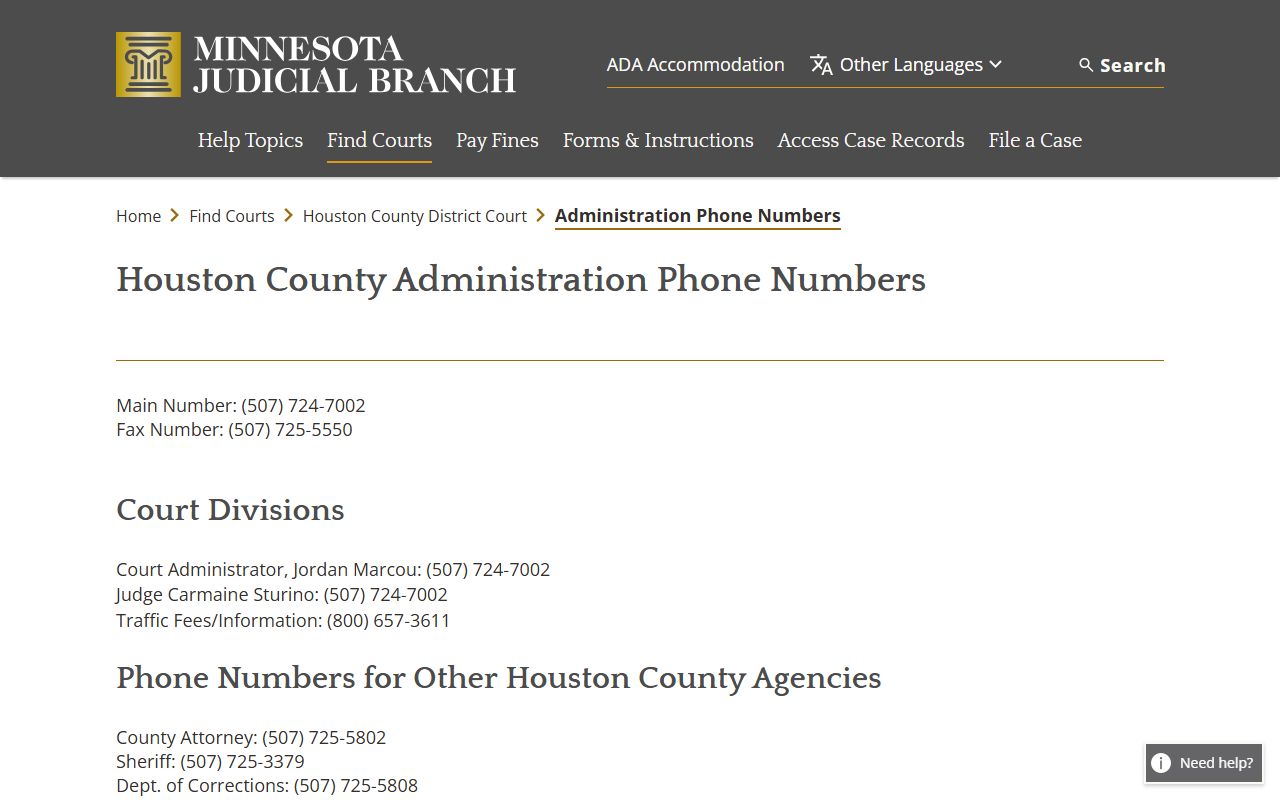
MCRO output is useful for public traffic case discovery, but county staff remains the channel for certified court-file copies and unresolved access gaps.
Which Courts Handle Traffic Cases in Houston County
Houston County traffic files follow the District Court track and are not kept in a separate county or municipal trial-court portal. City police can issue tickets and city attorneys may appear in some local enforcement paths, but the searchable filing channel is the District Court file environment.
For practical planning, separate the enforcement side from the court side from the start.
| Court or Office | Role | Address |
|---|---|---|
| Houston County District Court | Holds the case file for traffic matters as part of general trial-court jurisdiction. | Houston County Justice Center, 306 S. Marshall Street, Caledonia, MN 55921 |
| City Police Departments | Issue citations, collect incident context, and coordinate law enforcement reporting. | City-specific police offices; Houston, La Crescent, Caledonia, and county jurisdictions. |
| Minnesota DVS | Maintains statewide driver history and license-status records. | Statewide agency via official DVS channels |
| Houston County Court Administration | Provides certified copies and official custodian support for court traffic records. | Houston County Justice Center, 306 S. Marshall Street, Caledonia, MN 55921 |
Key point: Traffic court records in Houston County are court records; driver history and license consequences are in DVS systems.
Types of Traffic Cases on Record
Traffic case categories span moving violations, non-moving infractions, and enforcement actions that progress from citation to hearing or resolution. A filing can start as a citation or as a docket entry after local issuance and transfer processes.
Research for Houston County confirms that traffic case records are best interpreted by reading case type and event context from court records.
- Moving violations - speed, lane, signal, and right-of-way based events.
- Non-moving traffic matters - parking exceptions, signs, and stop-related enforcement types.
- DWI-related traffic files - many are handled through broader criminal pathways and can map into criminal records workflows.
- Photo enforcement - when available in a case file, appears as a case-level enforcement context.
- Commercial vehicle related traffic matters - often show federal or program-specific consequences in court notes and DVS outcomes.
Use the case number prefix and hearing text to identify exactly what the citation converted into in court.
What Houston County Traffic Court Records Show
Traffic case records typically include citation identity, filing status, hearing schedule, plea outcome, and court costs. Availability depends on case type, stage, and privacy restrictions.
| Field | What It Shows |
|---|---|
| Citation number | Ticket number tied to the original issuance and filing path. |
| Case number | Houston County court identifier after docket conversion. |
| Charge statute | Traffic code or offense cited in the court-facing record. |
| Case category | Traffic, criminal, family, civil, probate, or other category as filed. |
| Court date | Scheduled hearing date and related appearance timing. |
| Disposition | Dismissed, plea, guilty, pending, or other outcome marker. |
| Fine and costs | Monetary obligation data shown to the extent it is public in the case entry. |
| License impact notes | Court-level notes related to points or consequences when reflected in the file. |
| Hearing and motion history | Events shown in Register of Actions and hearing entries. |
Court traffic records are not full license files. They are one lane of the enforcement-to-court workflow.
Searching by Citation Number vs by Name
Use citation number when you have the ticket. Use name search to cross-check party matches, and use case number when name search returns no traffic results.
Pending matters can be the source of misses. Pending criminal, traffic, and petty misdemeanor cases may not return by defendant-name search depending on case status and conviction status.
| Search Field | Type | Required | Notes |
|---|---|---|---|
| Citation number | Text | Yes if known | Best for direct ticket-to-case workflows. |
| Case number | Text | Yes if known | Best when citation converted and docketed as case file. |
| Name fields | Text | Yes for name tab | Use exact spelling and optional soundex tools if available. |
| Case category | Checkboxes | No | Use Traffic where available for tighter results. |
| Court location | Radio + county selector | No | Use County to keep results local to Houston County. |
Paying or Contesting a Houston County Traffic Ticket
Houston County uses a practical two-track process: official case outcome handling in court records and payment or hearing workflow tied to the filing result. In many tickets, the citation itself has contact instructions for the amount and payment line.
When you need action, use the ticket and case record channels together.
- Find the ticket number and filing details from the citation.
- Search MCRO by citation number for the active case row.
- Call Houston County traffic information line at (800) 657-3611 for amount and payment method confirmation.
- If pleading not guilty, follow the notice instructions and request hearing appearance as stated on the official court notice.
- If you can pay, note the total fees and confirmation path before submitting a payment.
- If hearing is missed, expect court consequences tied to the case, and contact the court office and Clerk side as needed.
Note: Traffic payment and hearing timing often differ by court assignment and case status, so do not assume a single statewide fee code covers every matter.
Public Access Laws for Traffic Court Records
Traffic court records follow the same Minnesota access system used by other trial records. Rule 8 governs public access to judicial records. Rule 4 defines protected categories and restricted materials.
Most traffic outcomes and hearing entries are accessible when public limits allow. OFP, domestic abuse and harassment restraining orders, juvenile categories like CHIPS and Juvenile Delinquency Felony 16, and some civil commitment records have separate access handling and can be omitted online.
Apply access limits early so you do not overpromise what records are visible from MCRO.
Court Traffic Record vs State Driver Record
The two systems are separate. A traffic court case record tracks a filed citation and case process. A driver record tracks licensing status, conviction reporting, and history across incidents and agencies.
| Record Type | Source | What It Contains | How to Correct Errors |
|---|---|---|---|
| Court Traffic Record | Houston County District Court / MN Judicial Branch | Case filing, hearing date, pleas, disposition, fines, court documents. | Contact Court Administration or submit a case-correction request at the court channel. |
| State Driver Record | Minnesota DVS | License status, points, convictions reported to DVS, driving restrictions. | Use DVS request channels or correction process for driver-record disputes. |
| Judicial action outcome | Case file + hearings | Outcome as reflected in public docket and orders. | Court-file correction procedures. |
| Driving history output | DVS record request | Certified and non-certified history formats, where eligible. | DVS official request channels and agency correction process. |
CDL and Commercial Driver Records
Houston County traffic workflows may connect to CDL consequences when a citation involves commercial operation, but the same county-court versus state-driver split still applies. The court record remains the docket-level source for case outcomes; DVS remains the source for license and point outcomes.
Because commercial records and interstate enforcement details can include federal reporting contexts, confirm requirements directly with county and state offices before assuming local county court office authority over all CDL restrictions.
- Find the traffic case number and charge details in court records.
- Confirm whether the matter generated a driving consequence by checking DVS-facing channels.
- If consequences appear incorrect, request official review through the responsible office channels.
DUI / DWI Cases and Court Traffic Context
Most DUI and DWI cases can involve traffic and criminal legal pathways. If the case includes criminal adjudication rather than only citation-level traffic disposition, the primary pathway should be the criminal court record set.
For Houston County DUI/DWI coverage with charging context and criminal procedure details, use Houston County Criminal Court Records.
Deferred Adjudication and Defensive Driving Course
Defensive driving options, deferred adjudication outcomes, and related plea outcomes can affect both court and insurance consequences. Houston County traffic research does not provide a county-wide universal rule for course-specific outcomes.
Use the citation terms, hearing notice, and assigned judge instructions as the first source, and confirm any court-ordered treatment with Court Administration.
Sealing or Expunging Traffic Records
Traffic records can be sealed or expunged only under Minnesota legal standards. Sealed status affects what appears in public channels and can change future access through both court and third-party systems.
Where sealing and expungement apply, use the court record pathway for filing and status confirmation, then confirm downstream visibility in DVS or criminal-history systems as relevant.
Minnesota expungement statute is the main statutory reference for general expungement pathways in criminal-related contexts.
Fees for Traffic Record Copies
Use the court fee schedule for court-file copies. For driver-history requests, Minnesota DVS processing fees are published in the request form documentation.
| Item | Amount |
|---|---|
| Certified copy of civil or criminal court instrument | $14 |
| Exemplified and certified copy | $28 |
| Uncertified public court record copy | $0 |
| Case report 1-50 pages | $5 |
| Case report 50+ pages per 50 pages/part | $25 |
| Non-certified 5-year DVS request | $9 |
| Certified DVS request | $10 |
For exact DVS pricing, payment format, and mail channels, confirm through the official Minnesota DVS request process.
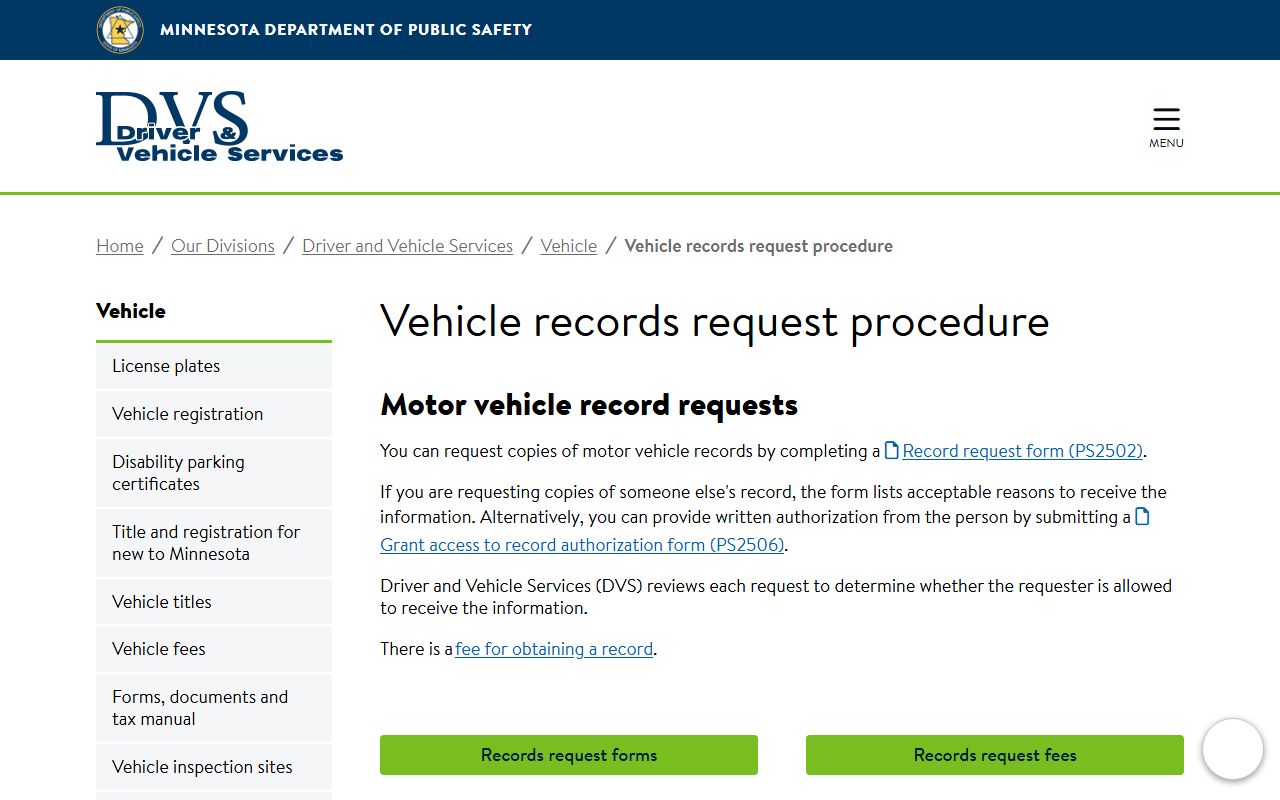
Minnesota DVS record request processUse the correct office and fee schedule so court copies are not confused with driver-history requests.